What Is a Protection Relay Tester and How Does It Work?
A protection relay tester is a professional electrical testing device used to verify whether protective relays operate correctly during faults such as overcurrent, overload, short circuit, voltage fluctuation, or frequency abnormalities. These relays are critical for protecting transformers, substations, generators, transmission lines, and industrial power systems.
By simulating real fault conditions, the tester helps engineers confirm relay accuracy, trip timing, and protection performance, improving power system safety and reliability.
How Does a Protection Relay Tester Work?
The tester generates precise voltage and current signals and injects them into the relay circuit. The relay reacts just like it would during an actual system fault.
Engineers can measure:
Trip time
Pickup current and voltage
Phase angle accuracy
Protection sequence
Differential protection performance
Modern relay testers also support automatic testing software, real-time waveform analysis, and report generation.
Wrindu RDJB-1600M Microcomputer Relay Protection Tester
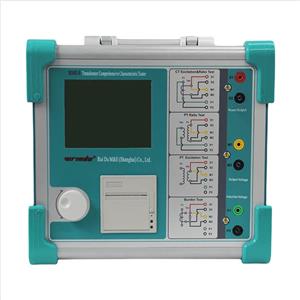
Wrindu RDJB-1600M Relay Tester is a multifunctional relay protection tester designed for substations, utilities, and industrial power systems.
Key Advantages of Wrindu Testers
Flexible Multi-Phase Output
The RDJB-1600M supports:
Six-phase voltage output
Six-phase current output
12-phase combined output mode
Three-phase transformer differential testing
This makes it suitable for both traditional relay testing and advanced differential protection analysis.
High Accuracy and Stable Waveforms
AC current output up to 180A parallel output
Frequency range: 0–1000Hz
Harmonic testing: 2nd–20th order
0.2 class measurement precision
Wrindu uses a high-fidelity linear power amplifier instead of a switching amplifier, ensuring lower waveform distortion and more stable output.
Intelligent DSP Control
The built-in DSP digital processing system provides:
Fast calculation speed
High-resolution waveform control
Stable signal generation
Real-time fault simulation
Powerful Testing Software
The software supports:
Automatic test sequences
Relay setting verification
Fault playback
Vector display
Real-time data storage
Online report printing
This greatly improves testing efficiency and reduces manual operation errors.
Comparison of Popular Protection Relay Testers
| Model | Output Channels | Voltage / Current Range | Communication Support | Main Application |
|---|---|---|---|---|
| Wrindu RDJB-1600M | 6 Voltage / 6 Current | 240V / 180A | USB Communication | Differential protection & substation testing |
| OMICRON CMC 356 | 6 Voltage / 6 Current | 300V / 32A | GOOSE, GPS Sync | Advanced relay calibration |
| Megger SMRT46 | 4 Voltage / 6 Current | 320V / 16A | PC Synchronization | Utility field maintenance |
Compared with similar products, the Wrindu RDJB-1600M offers stronger high-current output capability, flexible multi-phase combinations, lightweight portability, and cost-effective performance for utility and industrial applications.
Where Are Protection Relay Testers Used?
Protection relay testers are widely used for:
Substation commissioning
Transformer protection testing
Factory Acceptance Testing (FAT)
Site Acceptance Testing (SAT)
Preventive maintenance
Utility power system inspection
Renewable energy system testing
Regular relay testing helps reduce unexpected outages, improve grid reliability, and protect expensive electrical equipment.
Why Relay Testing Is Important?
Modern power systems rely heavily on protective relays. If a relay fails to operate correctly, faults can spread quickly and cause severe equipment damage or large-scale blackouts.
Professional relay testing helps engineers:
Improve protection reliability
Reduce maintenance costs
Detect hidden relay problems early
Ensure IEC and IEEE compliance
Enhance electrical safety
As digital substations and smart grids continue to develop, accurate relay protection testing becomes even more important for modern power system operation.