Insulation Resistance Tester

- Wrindu
- Shanghai, China
- about 10 working days
- 1000 set/month
- RD3215E
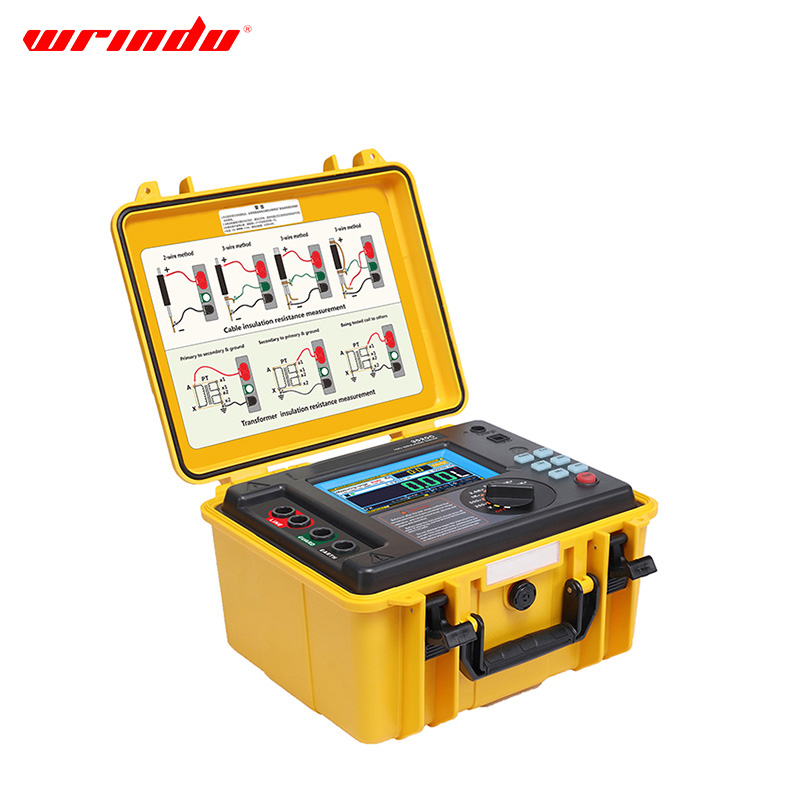
The RD3215E High Voltage Insulation Resistance Tester offers strong anti-interference performance for testing large high-voltage equipment and substation transmission lines. Its color touch screen provides clear readings and makes operation simple.
Product Description
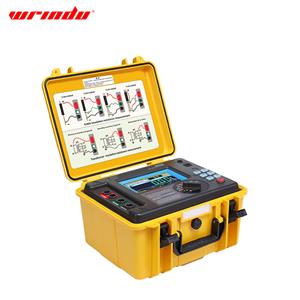
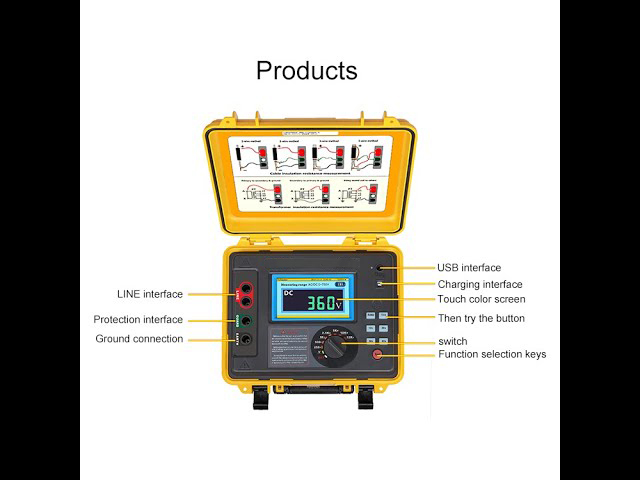
The RD3215E High Voltage Insulation Resistance Tester measures insulation resistance in large high-voltage electrical equipment and substation transmission lines. It offers strong anti-interference performance, making it suitable for testing in environments with high electrical interference.
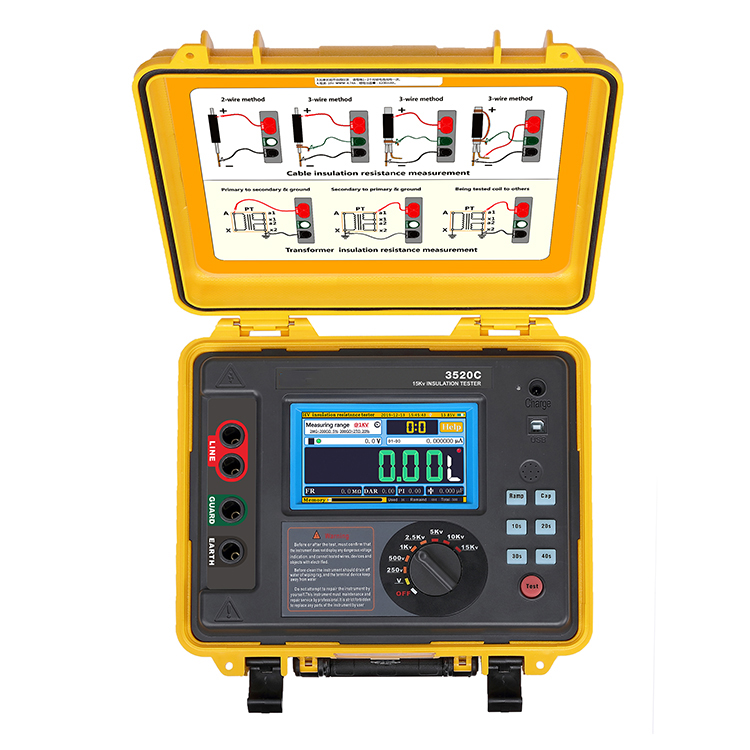
The tester has a color touch screen that shows test results and battery status clearly. Its knob and button controls make operation simple and convenient.
Product Features
Rechargeable Lithium Battery: The tester uses a high-capacity rechargeable lithium battery for convenient field testing.
Strong Anti-Interference: It delivers stable test results when testing long cables with high capacitance or working in substations with strong electromagnetic interference.
Color Touch Screen: Test results are displayed clearly on one screen. Users can also check previous test records directly on the instrument.
Flexible Test Settings: Users can select PI and DAR calculations, set the test voltage, and adjust the test duration to meet different testing needs.
Live Voltage Monitoring: The tester checks the voltage of the test object before testing. If the voltage exceeds 36 V, it blocks the test to help protect the operator and instrument.
Test Current Monitoring: The instrument displays the current flowing through the test circuit during measurement.
Temperature and Humidity Monitoring: Built-in sensors monitor the temperature and humidity inside the instrument.
Automatic Discharge: After testing, the instrument automatically discharges the test object, so no separate discharge circuit is needed.
Large Data Storage: The tester can store up to 1,000 sets of test records, including the test date and time. Users can review and analyze the data on the instrument.
USB Data Transfer: Test records can be uploaded to a computer for storage and further analysis.
Bluetooth Connection: Test results can also be sent to a mobile phone via Bluetooth.
For more insulation resistance test equipment, please click the insulation resistance test solution list
If your company has procurement needs, please click to contact us, we are always ready to provide you with quotes and solutions.
Applicaions
 |  |
Product Specification and Technical Parameters
1. Insulation Resistance Measurement Accuracy
Rate Voltage | 250V | 500V | 1000V | 2500V | 5000V | 10kV | 15kV | |
Range and Accuracy | ±5% | 50GΩ | 100 GΩ | 200 GΩ | 500 GΩ | 1 TΩ | 2 TΩ | 3TΩ |
±20% | 500GΩ | 1TΩ | 2 TΩ | 5TΩ | 10TΩ | 20TΩ | 30TΩ | |
2. Product specifications and technical parameters
Function | Description |
Function | Insulation resistance measurement (IR); polarization index measurement (PI) ;Dielectric Absorption Ratio Test (DAR); Ramp Test Mode (RAMP); filtered resistance test (10S, 20S, 30S, 40S); Voltage measurement (V); current measurement (nA); capacity measurement(uF) |
Power Supply | Rechargeable lithium battery pack 6.2Ah |
Rated Voltage | 250V, 500V, 1kV, 2.5kV, 5kV, 10kV, 15kV |
Output Voltage Accuracy | (5%~10%)±10V |
Insulation Resistance Range | 0.5MΩ~30.0TΩ |
Short Circuit Current | 7mA Max |
Polarization Index Test | Yes |
Dielectric Absorption Ratio Test | Yes |
Ramp Test Mode | Test in steps of 10% of the preset voltage until the preset voltage |
Filtered Resistance Test Mode | 10S, 20S, 30S, 40S |
Voltage Measurement | Range: AC/DC 0V~1000V; Accuracy: ± 5%rdg±3V |
Leackage Current Measurement | Range: 0.01nA~7mA; Accuracy: ± 5%rdg+0.5nA ; |
Capacitance Measurement | Range: 10nF~25uF; Accuracy: ± 10%rdg ± 10 nF |
Voltage Monitor | Monitor the voltage of the measured object, and monitor discharge status after test, Forbidden to test when voltage is larger than 36V, protect instrument and operator. |
Test Time | Automatic record test time, time range: 0s~9999s |
Storage Function | Automatically store the test data with test date and time, total of 1000 groups |
Upload Function | Upload the stored data to computer with USB communication cable. |
Battery Power Display | With battery power display, when battery voltage low will remind to charging the battery |
Automatic Shutdown | After 15 minutes start up will shut down automatically without any operation |
Meter Dimension | 280mm×260mm×160mm |
Weight | 4900g |
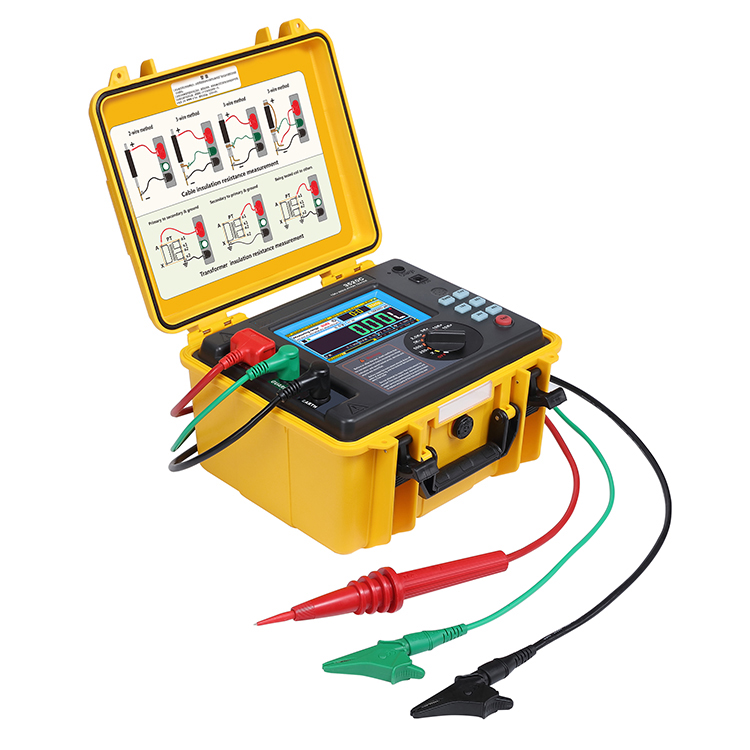
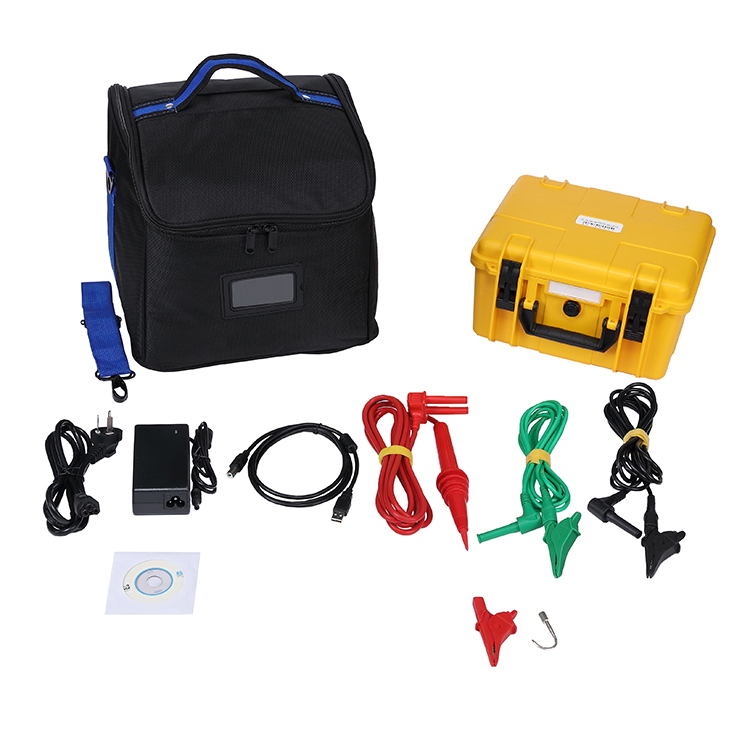
Test Wire | Red color high voltage test wire 1 pc (with alligator clip 1 pc and hook 1 pc), green color test wire 1 pc, black color test wire 1 pc |
Protection Level | Close the case IP65, open the case IP40 |
Working Temperature and Humidity | -20℃ ~ 50℃, 80%RH |
Storage Temperature and Humidity | -25℃ ~ 65℃, 80%RH |
Insulation Resistance | 50MΩ (1000V) (between the test circuit and shell) |
Withstand Voltage | AC 3kV 50Hz 1min (between the test circuit and shell) |
Suitable Safety Standard | IEC61010-1, IEC61326-1 |
How Does the RD3215E Help Engineers Test Insulation Resistance?
Insulation resistance testing helps engineers assess the condition of electrical insulation in power equipment. It can reveal signs of moisture, contamination, or insulation deterioration. However, test results depend on the equipment type, test voltage, temperature, and testing conditions.
The Wrindu RD3215E supports several measurement methods to help engineers carry out different insulation tests.
Insulation Resistance (IR): Measures the resistance between conductors and ground, or between isolated electrical parts.
Polarization Index (PI): Compares insulation resistance readings taken at different times to help assess insulation condition.
Dielectric Absorption Ratio (DAR): Compares resistance readings at selected time intervals to evaluate changes during the test.
Ramp Test: Increases the test voltage in steps of 10% of the preset voltage until it reaches the target value.
Filtered Resistance Test: Offers 10, 20, 30, and 40-second measurement settings to help reduce the effect of interference on readings.
These functions give engineers more options when testing different types of electrical equipment. The correct method and test voltage should follow the equipment manufacturer's instructions and the applicable testing standard.
What Equipment Can the RD3215E Test?
The RD3215E is designed for insulation resistance testing in demanding electrical environments. Its measurement functions and anti-interference capability make it suitable for applications such as:
Power transformers and other high-voltage equipment: Check insulation resistance during maintenance and condition assessment.
Substation equipment: Carry out insulation tests in environments where electromagnetic interference may affect measurements.
Long power cables: Measure insulation resistance in cables with high distributed capacitance.
Transmission and distribution equipment: Support routine inspection and maintenance of electrical insulation.
Industrial electrical systems: Check insulation condition before equipment returns to service, where the test is appropriate.
Before testing, engineers should confirm that the selected test voltage is suitable for the equipment under test. The RD3215E supports rated test voltages from 250 V to 15 kV, allowing users to select a suitable setting for different applications.
What Should Engineers Check Before an Insulation Resistance Test?
Correct preparation helps improve test reliability and reduce safety risks.
1. Is the equipment fully isolated?
Disconnect the equipment from its power supply and follow the required lockout and isolation procedures. Verify that the equipment is de-energized before connecting the tester.
2. Is the selected test voltage suitable?
The RD3215E offers seven rated test voltage settings: 250 V, 500 V, 1 kV, 2.5 kV, 5 kV, 10 kV, and 15 kV. Select the voltage according to the equipment rating and the manufacturer's testing requirements.
3. Could electrical interference affect the reading?
Substations and long cables can create challenging measurement conditions. The RD3215E uses anti-interference technology to support stable measurements in these environments. Proper test lead connections and suitable test conditions remain important.
4. Has the test object been discharged?
After testing, allow the instrument's automatic discharge function to operate. Verify that the test object has reached a safe voltage before touching the test leads or equipment. Follow the equipment manufacturer's safety instructions throughout the process.
The RD3215E also monitors the voltage of the test object and blocks testing when the detected voltage exceeds 36 V. This function provides an additional safeguard, but it does not replace proper isolation and voltage verification.
How Can Engineers Interpret Insulation Resistance Test Results?
A high insulation resistance reading generally indicates lower leakage through the insulation under the test conditions. A low reading may indicate moisture, contamination, aging, or other insulation problems.
However, one reading alone cannot confirm the overall condition of electrical insulation. Engineers should consider the following factors when reviewing the results:
| Factor | Why It Matters |
|---|---|
| Test voltage | Different equipment and insulation systems may require different test voltages. |
| Test duration | Resistance can change during a test, affecting PI and DAR calculations. |
| Temperature | Insulation resistance can vary with temperature, so comparisons may require temperature correction. |
| Equipment history | Comparing results from previous tests can help identify changes over time. |
| Test connections | Poor connections, surface contamination, or interference may affect readings. |
The RD3215E measures insulation resistance from 0.5 MΩ to 30 TΩ and can store up to 1,000 test records with the date and time. Engineers can review the stored results on the instrument or transfer the records to a computer through USB for further analysis.
For reliable condition assessment, compare results with the equipment manufacturer's limits, applicable standards, and previous measurements taken under comparable conditions.
Wrindu Technical Support for Insulation Resistance Testing
Selecting an insulation resistance tester requires more than checking the maximum test voltage. Engineers should also consider the equipment under test, expected resistance range, site conditions, safety requirements, and data management needs.
Wrindu provides high-voltage electrical testing equipment for power utilities, electrical maintenance teams, testing laboratories, and industrial users. For the RD3215E, buyers can contact the Wrindu team to confirm technical specifications, test voltage selection, operating procedures, and available product documentation before ordering.
For assistance with product selection or a quotation, contact Wrindu.