What Does Creeping Leakage Current Mean in High Voltage Testing?
What Does Creeping Leakage Current Actually Mean?
A gradual rise in leakage current is rarely a random fluke. Instead, it serves as an early warning sign that an electrical insulation system is aging, contaminated, or under excessive stress.
In high-voltage testing laboratories, monitoring these subtle shifts in the nanoampere (nA) range allows engineers to detect deep-seated insulation issues long before a catastrophic breakdown occurs.
Why Does Leakage Current Trend Upward Instead of Staying Stable?
When insulation materials are subjected to continuous electrical stress, their overall resistance can degrade over time. A creeping increase in current under constant voltage usually points to one of three common issues:
Moisture and Contamination: Dirt, moisture, or chemical residues slowly build up on the surface, creating a thin, conductive film.
Thermal Runaway: Localized weak spots in the insulation heat up, which in turn increases conductivity and draws even more current.
Partial Discharge Channels: Microscopic cracks or voids inside solid dielectrics begin to break down, forming progressive electrical pathways.
While a healthy insulation system will show a brief spike during the initial charging phase and then flatten out, a continuous upward drift indicates an active, progressing fault.
How Do You Differentiate Between Good and Bad Leakage Current Data?
Accurate data analysis is essential to avoid misdiagnosing a healthy component or missing a critical flaw.
Characteristics of Good Data
Reproducible: Yields the same results when the test is repeated under identical conditions.
Stable: Flattens out over the duration of the test after filtering out initial capacitive charging and background noise.
Consistent: Aligns closely with the expected baseline values of similar reference models.
Characteristics of Bad Data
Noisy and Erratic: Displays unexplained spikes, fluctuations, or continuous upward drifting.
Environmentally Sensitive: Changes drastically with minor fluctuations in ambient humidity or temperature.
Inconsistent: Produces widely different results during back-to-back testing on the exact same unit.
Pro Tip: To confirm an insulation fault, discharge and cool the system completely, swap the test leads to rule out fixture leakage, and run a parallel test against a known-good reference sample.
What Does a Voltage vs. Leakage Current (I-V) Graph Tell Us?
Plotting voltage against leakage current maps out exactly how an insulation system behaves under increasing electrical field strength. Engineers primarily look for three distinct patterns on an I-V curve:
| I-V Curve Characteristic | Physical Meaning & Diagnostic Interpretation |
| Flat Plateau (Post-Charging) | Healthy insulation; current is primarily transient displacement. |
| Linear, Proportional Rise | Standard ohmic leakage current, usually caused by volume conductivity. |
| Gentle Upward Curvature | Space charge accumulation; early electrical stress in solid insulation. |
| Sharp Bend or Sudden Spike | Active partial discharge, surface tracking, or an imminent breakdown. |
| Erratic Jumps or Noise | Surface flashovers, loose testing connections, or external interference. |
How Can You Troubleshoot Creeping Leakage Current in a Factory Setting?
If your testing equipment registers a creeping leakage current, follow this step-by-step diagnostic checklist to isolate and resolve the issue:
Verify the Testing Instrument: Run a self-test, verify the equipment's calibration, and measure open or shorted test fixtures to eliminate internal errors.
Inspect Leads and Fixtures: Check all connections for visible cracks, dust, moisture, or surface carbon tracks.
Control the Environment: Stabilize the room temperature, lower the humidity, and eliminate rapid airflow around high-voltage setups.
Clean and Dry the Surfaces: Wipe down the component's surface using approved solvents and controlled heat to remove conductive residues.
Test Against a Reference: Run the exact same test sequence on a known-good component to confirm if the issue lies with the fixture or the item under test.
Adjust the Test Profile: Optimize the voltage ramp rate, soak time, and maximum voltage limits to prevent over-stressing the dielectric material.
Escalate Diagnostics: If the drift persists, utilize advanced testing methods like partial discharge (PD) testing, infrared thermography, or offline insulation resistance analysis.
FAQs
What is the difference between leakage current and insulation resistance?
Leakage current is the actual, measurable electrical current that slips through or flows across an insulation barrier at a specific voltage. Insulation resistance is a calculated value derived from that current using Ohm's Law. While both indicate insulation health, leakage current provides a direct, real-time look at how the system reacts to specific test voltages.
Can minor increases in leakage current during factory testing be ignored?
No. Even tiny, steady increases over time or voltage steps are early indicators of insulation degradation, moisture ingress, or surface contamination. Ignoring these nanoampere-level shifts can lead to premature equipment failure once the component is deployed under full operational loads.
Are AC and DC leakage current tests interchangeable?
They are complementary rather than interchangeable. DC testing is highly sensitive to pure insulation resistance, polarization effects, and internal moisture. AC testing, on the other hand, better simulates real-world operating stress and accounts for the capacitive behavior of the insulation system. High-voltage manufacturers often perform both to ensure a comprehensive diagnosis.
How often should high-voltage equipment be tested for leakage current?
The ideal testing frequency depends on how critical the asset is and the environment it operates in. Generally, main power transformers, circuit breakers, and high-voltage cables should be re-tested every 1 to 3 years. Testing should be done more frequently if the equipment operates in harsh environments, or immediately following an operational overload, short circuit, or major repair.
How much do environmental conditions affect leakage current test results?
Environmental factors can alter your readings by multiple orders of magnitude. High relative humidity creates a conductive moisture film on insulation surfaces, while elevated temperatures naturally increase the mobility of ions within dielectric materials, driving up the leakage current. For accurate trend analysis, always record ambient temperature and humidity alongside your testing data.
How Wrindu RDZG Improves Leakage Current Measurement Accuracy?
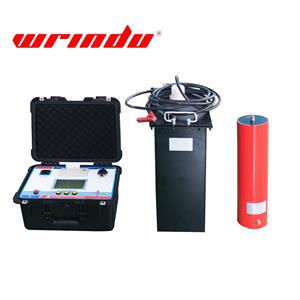
The Wrindu RDZG DC High Voltage Generator (60kV / 10mA DC Hipot Tester) is designed to measure leakage current with high stability and accuracy. Using PWM closed-loop control, it ensures low ripple (≤0.5%) and very stable output voltage, which is critical for detecting creeping leakage current in insulation systems. Even small nanoamp-level changes can be clearly observed without interference from voltage fluctuation.
With high-resolution current measurement (down to 0.1 μA) and full protection functions such as over-voltage, over-current, and short-circuit protection, the RDZG helps engineers accurately identify insulation aging, moisture, or partial discharge issues. Its smooth voltage regulation also supports reliable I–V curve analysis, making it a practical tool for cable, transformer, and arrester insulation testing in both field and laboratory environments.