VLF Hipot Testing Case Study: How Utility Prevented High-Voltage Cable Outage
Why Early Cable Insulation Testing Is Critical for Power Utilities?
High-voltage and medium-voltage underground cable insulation failure is one of the most common and dangerous faults in modern power distribution systems. Aging cables, hidden moisture ingress, loose joint insulation, and long-term electrical stress can gradually degrade dielectric performance.
Most insulation defects show no visible external signs, making them impossible to detect through routine visual inspections.
Without professional high-voltage diagnostic testing, minor insulation degradation will eventually develop into sudden breakdowns, causing unplanned power outages, equipment damage, and huge economic losses for industrial zones and urban power grids. For this reason, Very Low Frequency (VLF) Hipot testing has become the industry-standard preventive maintenance method for aging cable networks.
Project Background: Hidden Risks in Aging Underground Cable Network
A regional power utility in charge of industrial zone power supply faced growing operational pressure from its aging medium-voltage underground cable system. After years of continuous operation, the entire cable network began showing unstable operating signs, which greatly increased maintenance risks.
The core challenges the utility faced included:
Long-term cable aging leading to gradual insulation performance decline
Frequent minor leakage current fluctuations during peak load periods
No effective way to inspect buried underground cable internal conditions
High risk of sudden insulation breakdown and large-scale power outages
Traditional daily inspections could only monitor real-time operating parameters but could not locate hidden weak insulation points. The utility urgently needed a reliable, non-destructive high-voltage testing solution to evaluate cable health status without shutting down power supply.
Testing Objectives for Cable Insulation Diagnosis
To eliminate hidden cable faults and optimize maintenance strategies, the utility formulated clear testing goals for this VLF Hipot diagnostic project:
Accurately locate weak insulation sections and defective cable joints
Verify cable dielectric strength under simulated long-term AC operating stress
Prevent sudden cable breakdown and unexpected industrial power outages
Establish standardized condition-based maintenance for aging cable assets
Why VLF Hipot Testing Was Selected for Cable Inspection?
Compared with traditional power-frequency Hipot testing, VLF very low frequency high-voltage testing is more suitable for medium and high-voltage cable insulation detection, especially for long-distance buried cable lines.
The engineering team chose VLF testing for the following key advantages:
VLF AC voltage perfectly simulates actual cable operating stress, ensuring authentic test results
Lightweight and portable design adapts to complex underground cable construction environments
Lower test energy and higher safety, no damage to qualified healthy insulation
High sensitivity for early aging, moisture contamination and joint insulation defects
Standard VLF Hipot Test Procedure On-Site
The team followed standardized professional testing procedures to ensure accurate and repeatable diagnostic results:
Step 1: On-site preparation and safety isolation
Isolate the tested cable section and complete safety grounding to eliminate external electrical interference.
Step 2: Step-by-step VLF high-voltage application
Apply graded very low frequency AC voltage according to industry standards to simulate long-term operating load.
Step 3: Real-time leakage current monitoring
Continuously track leakage current changes and insulation response status under high voltage stress.
Step 4: Data recording and defect judgment
Analyze abnormal current fluctuations and locate early insulation degradation areas accurately.
Key Test Findings: Hidden Early-Stage Insulation Defect Detected
After systematic VLF Hipot testing, the engineering team successfully found a critical hidden fault that could not be discovered by conventional monitoring methods.
The core test findings included:
One cable segment showed obvious abnormal rising leakage current under VLF stress
The defect was concentrated in a cable joint, a high-risk weak point for aging lines
No external damage or breakdown signs appeared, belonging to typical early insulation aging degradation
If left undetected, this subtle insulation defect would have gradually deteriorated under continuous power load, eventually causing sudden cable breakdown and industrial zone power outage.
Targeted Maintenance Actions Taken by the Utility
Based on accurate VLF test data, the utility immediately formulated targeted maintenance plans to eliminate hidden dangers:
Completely replaced the defective cable section and aging joint accessories
Reinforced waterproof and insulation protection for all cable joints on the line
Adjusted the maintenance cycle of all aging feeders for focused supervision
Established a regular VLF testing mechanism for annual cable health assessment
Project Results & Operational Benefits
After completing defect rectification and standardized VLF testing, the power grid operation stability was significantly improved, bringing long-term value to the utility:
Avoided major power outages: Eliminated potential sudden cable failure risks and guaranteed stable power supply for industrial users.
Improved power system reliability: Reduced hidden faults of distribution network and improved grid anti-risk capability.
Cut down maintenance costs: Early preventive repairs avoided expensive emergency troubleshooting and large-area cable replacement.
Optimized asset management: Formed cable health files through test data, realizing scientific condition-based maintenance.
Core Advantages of Wrindu 80kV VLF Integrated Tester
1. Ultra-High 80kV Full-Range Test Capacity for High-Voltage Cables
Supports max 80kV peak AC output and optional 80kV DC withstand testing, fully covering medium and high-voltage cable insulation withstand requirements. It adapts to long-distance XLPE power cables with strong load capacity: up to 4.0μF cable load @ 0.01Hz, meeting large-capacity on-site cable testing demands.
2. Multi-Speed Auto Variable Frequency & Ultra-Stable Output
With <0.5% frequency stability and ≤3% waveform distortion & voltage error, it outputs standard true sine wave without capacitive overvoltage, ensuring ILF/IEC-standard compliant insulation stress simulation.
3. High-Precision Full-Parameter Measurement
Voltage & current accuracy: ±3%
Current resolution: 0.1mA
Optional DC leakage current test: 0–2000μA range, 1μA resolution
All data are sampled directly at the HV side, ensuring authentic and reliable test results without signal loss.
4. Intelligent Visual Operation & Complete Data Management
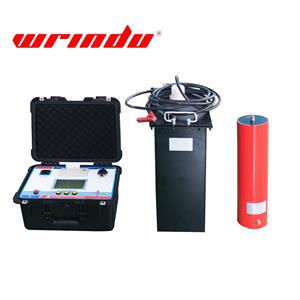
Equipped with 154*86mm large color touch screen, supporting real-time voltage/current waveform display. Built-in printer and local data storage support result retrieval, export via USB/RS232, and one-click report generation, greatly improving field testing efficiency.
5. Multiple Safety Protection & Isolation Design
Adopts optical isolation technology and H/L closed-loop negative feedback control. Integrated over-voltage, over-current protection and built-in protective resistors completely avoid high-voltage risks, ensuring stable and safe long-time operation (max 60 mins continuous working).
6. Rugged Portable Structure for Harsh Field Environments
Adopts imported mixed resin crashproof box design. Works stably from -10°C to +50°C, ≤85%RH, suitable for outdoor substations, construction sites and all-weather field cable diagnosis.
7. Dual AC/DC Integrated Function (Optional)
FAQs
Q1: What is a VLF Hipot Tester used for in power systems?
A: A VLF Hipot Tester applies very low frequency high voltage to detect hidden insulation aging, moisture ingress and joint defects in medium and high-voltage cables, ensuring safe cable operation.
Q2: Why is VLF testing better than traditional power frequency testing for cables?
A: VLF testing features lower capacity demand, safer operation, and higher sensitivity to early cable insulation degradation, making it more suitable for long-distance buried cables.
Q3: Can VLF Hipot testing prevent sudden cable outages?
A: Yes. It detects early-stage invisible insulation weaknesses before breakdown occurs, allowing maintenance teams to eliminate risks in advance.
Q4: What kind of cable defects can VLF testing find?
A: It effectively identifies insulation aging, water tree defects, moisture contamination, poor cable joint insulation and partial discharge faults.
Q5: How often should medium voltage cables undergo VLF testing?
A: New cables can be tested every 2–3 years, while aging cables and key industrial power supply lines require annual VLF preventive testing.
Q6: Does VLF high-voltage testing damage healthy cable insulation?
A: No. Standard VLF test voltage and time will not damage qualified insulation, belonging to safe non-destructive preventive testing.
Q7: What makes Wrindu VLF testers different from ordinary models?
A: Wrindu integrated VLF testers combine multiple diagnostic functions, with higher detection sensitivity, stronger anti-interference ability and complete data analysis functions for professional power maintenance.
Conclusion
Aging underground cable systems have always been a key hidden danger restricting power grid safe operation. Traditional inspection methods cannot identify early invisible insulation defects. This practical case fully proves that standardized VLF Hipot testing is an efficient and reliable preventive maintenance solution for medium and high-voltage cables.
By adopting Wrindu professional VLF integrated testing equipment, power utilities and engineering teams can accurately locate hidden faults, realize early warning of insulation degradation, avoid unexpected power outages, reduce maintenance costs, and continuously improve the reliability and safety of power distribution systems.
Related Articles
How to use VLF Withstand Voltage Generator?
What do you know about VLF Testing, TD Testing and PD Testing?
HV cable testing: Risks and Benefit between DC and VLF Hipot Methods.