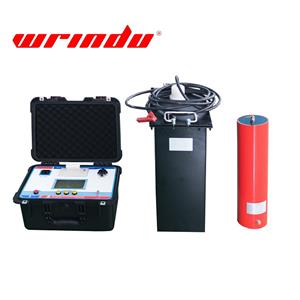
60KV VLF Hipot Tester | 0.01-0.1Hz Auto Frequency VLF Tester with Tan Delta PD DC Test



- Wrindu
- Shanghai, China
- about 10 working days
- 1000 set/month
- RDVLF-Z60YTF
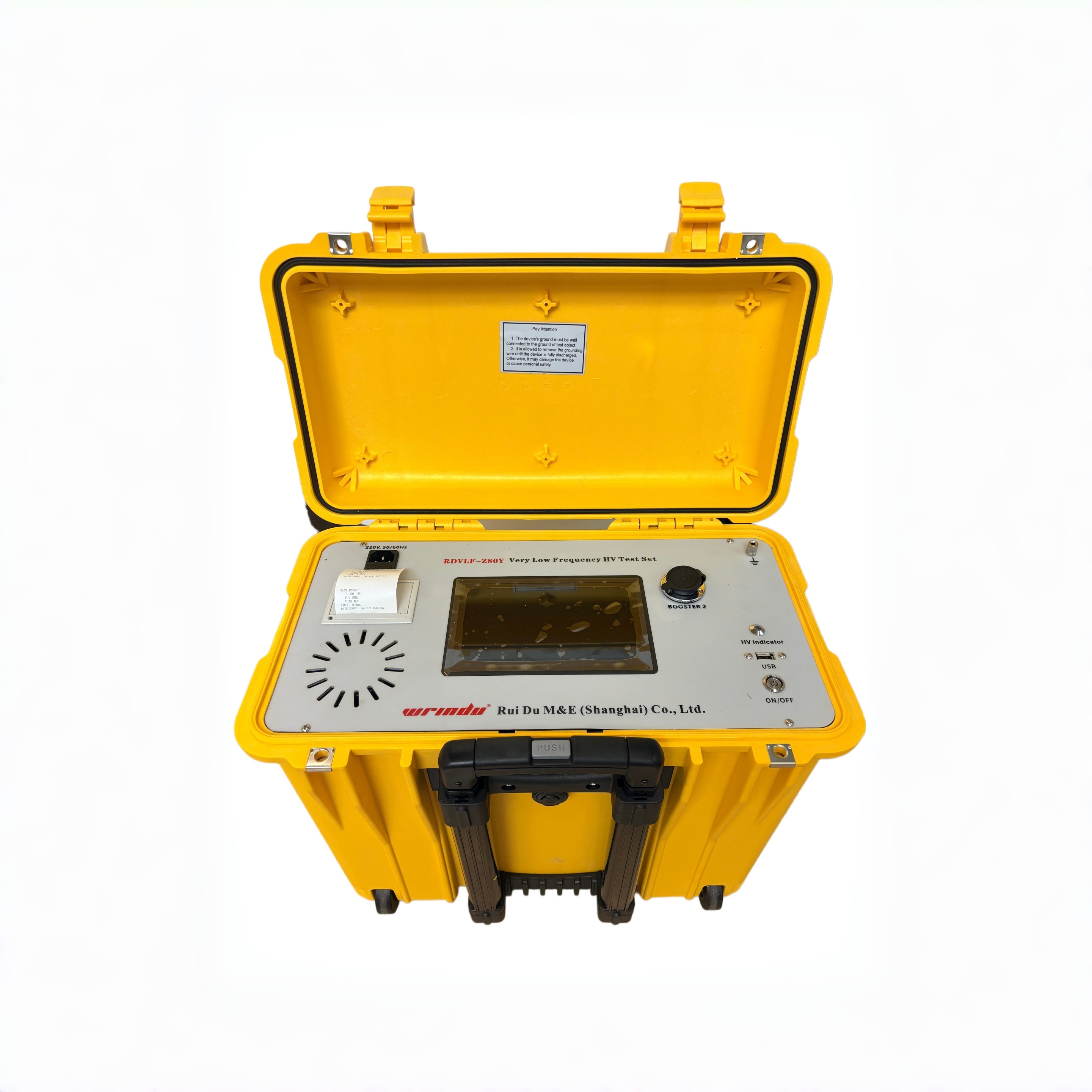
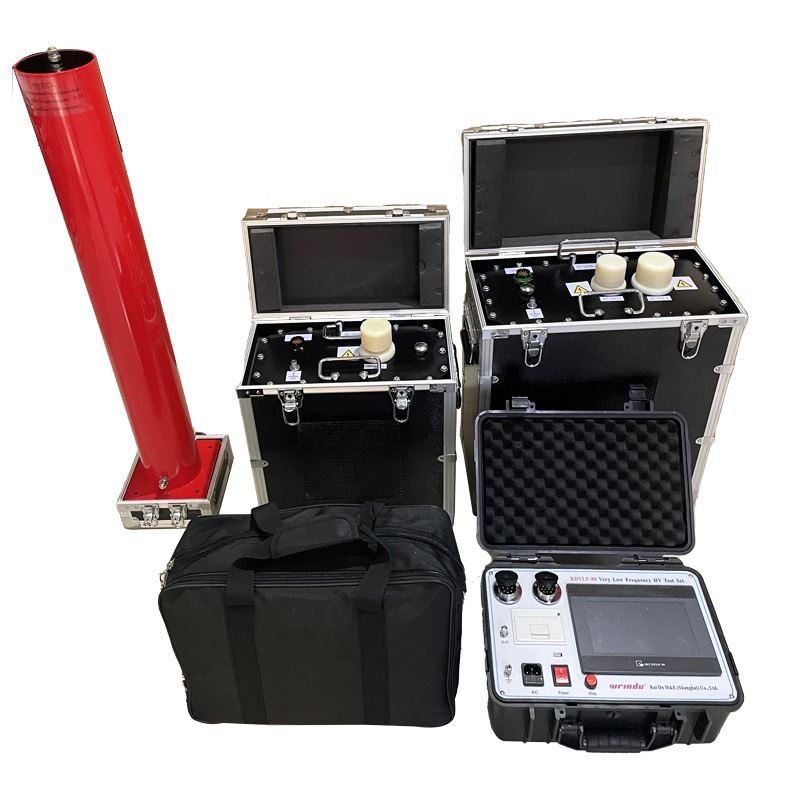
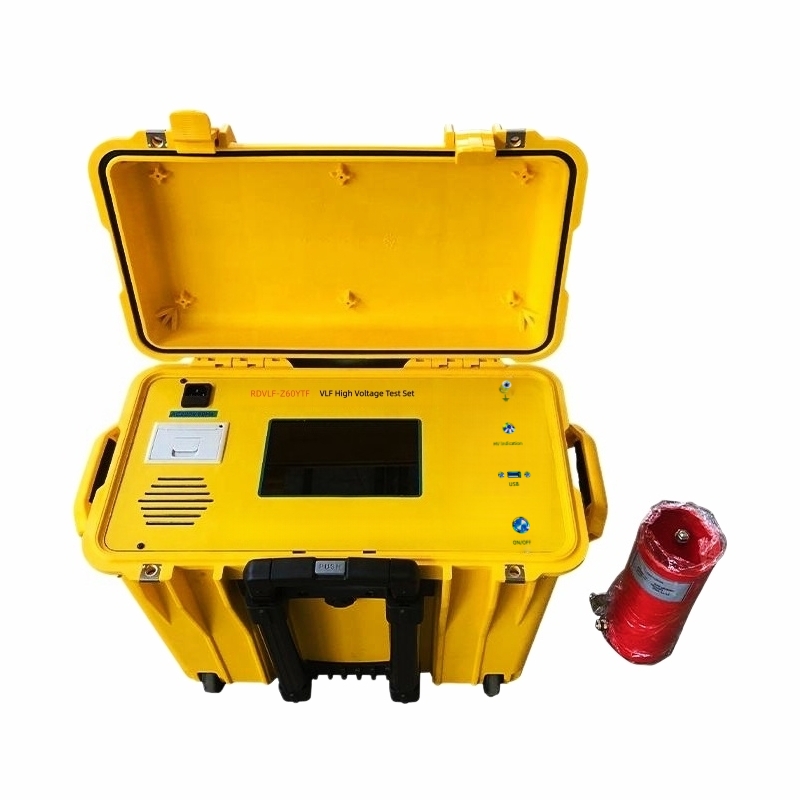
The 60 kV VLF Hipot Tester is designed for insulation testing of high-voltage cables and transformers. It offers AC output from 1 to 60 kV and automatically adjusts the test frequency to 0.01, 0.02, 0.05, or 0.1 Hz. The unit combines VLF withstand voltage, tan delta (tgδ), partial discharge (PD), and DC leakage current tests. It provides ±3% measurement accuracy, operates at temperatures from -10°C to +50°C, and supports continuous operation for up to 60 minutes.
Product Features
1. AC withstand voltage testing with real-time voltage & current curve synchronous display 2. Integrated tan delta (tgδ) and capacitance (μF) testing, no external devices required 3. Built-in partial discharge testing function, free of additional external equipment 4. DC withstand voltage testing + real-time DC leakage current measurement 5. Tan delta test results analyzed in compliance with IEEE 400.2 standard 6. Advanced safe optical isolation technology for high-low voltage circuit isolation 7. Full-automatic microcontroller core, ultra-simplified one-key operation logic 8. H/L voltage closed-loop negative feedback control, no output capacity rise effect 9. Built-in high-speed printer for on-site immediate test report printing 10. Integrated protective resistors, effectively limit short-circuit/overcurrent during testing 11. 154*86mm color touch LCD screen, standard true sine wave output 12. Real-time dynamic display of actual test voltage/current output waveform 13. Ergonomic large color touch screen, intuitive menu-guided step operation 14. Large-capacity memory for test result storage, flexible retrieval and printing 15. Intelligent over-voltage & over-current dual protection, automatic power-off alarm 16. Auto variable frequency output (0.01Hz/0.02Hz/0.05Hz/0.1Hz) for multi-scenario adaptation 17. Optimized heat dissipation, 60 mins continuous stable full-load working 18. Current/voltage/waveform directly sampled at HV side, ensuring data authenticity 19. Portable rugged trunk design, US-made special mixed resin outer box 20. Core technology with national invention patent certification 21. Compliant with EU CE certification, meets international quality & safety standards 22. RS232/USB communication interfaces optional, support PC terminal data interaction
For more hv testing equipment, please click high voltage tester list.
Product Specifications and Technical Parameters
| Item | Specification |
|---|---|
| Power Supply | 220V ± 10% AC (110V customizable), 50/60Hz, single phase |
| AC Output Peak Voltage | 1 ~ 60 KV |
| Output Frequency | 0.1Hz, 0.05Hz, 0.02Hz, 0.01Hz (auto variable frequency) |
| Load Capacity | 0.5μF @ 0.1Hz; 1.0μF @ 0.05Hz; 2.5μF @ 0.02Hz; 5.0μF @ 0.01Hz |
| Frequency Stability | Fluctuation < 0.5% |
| AC Voltage Measurement Accuracy | ±3% |
| AC Voltage Measurement Resolution | 0.1KV |
| AC Current Measurement Accuracy | ±3% |
| AC Current Measurement Range & Resolution | 0 ~ 20mA, 0.1mA |
| Positive & Negative Voltage Peak Error | ≤3% |
| Voltage Waveform Distortion | ≤3% |
| Construction | 1×60KV integrated device |
| Operating Ambient Temperature | -10℃ ~ +50℃ (indoor & outdoor) |
| Operating Ambient Humidity | ≤85% |
| VLF tgδ Test Technical Indexes | 1. Test voltage range: 1 ~ Rated value (60KV) 2. Measurement voltage accuracy: 1% 3. Dielectric loss test frequency: 0.1Hz 4. Dielectric loss measurement range: 0.01×10⁻³ ~ 655.35×10⁻³ 5. Dielectric loss accuracy: 1×10⁻⁴ 6. Dielectric loss resolution: 1×10⁻⁵ 7. Capacitance measurement range: 0.001μF ~ 10μF 8. Capacitance resolution: 0.001μF 9. Current measurement range: 0 ~ 20mA 10. Current resolution: 0.1mA |
| VLF PD Test Technical Indexes (Optional) | 1. Partial discharge measurement range: 1pc ~ 5000pc (2000 displayed when exceeding 5000) 2. Partial discharge detection resolution: 1pc 3. PD measurement accuracy: 3% 4. Capacitance range: 0.001μF ~ 10μF 5. Sampling bits: 12 bits 6. Sampling speed: 200M/S 7. Test voltage: 0 ~ Rated value (KV) |
| DC Leakage Current Measurement (Optional) | 1. DC output rated voltage: +60K V2. DC voltage accuracy: 3% 3. Leakage current range: 0 ~ 2000μA (customizable) 4. DC current resolution: 1μA 5. DC current accuracy: 3% |
FAQs
A: It integrates AC/DC withstand voltage, tan delta, capacitance, partial discharge and DC leakage current testing; no external devices are required for all core tests.
A: It adopts HV side direct sampling for current/voltage/waveform, closed-loop negative feedback control, and high-precision measurement indexes to ensure authentic and accurate data.
A: It has optical isolation for high-low voltage circuits, integrated protective resistors, and intelligent over-voltage/over-current dual protection with auto power-off and alarm.
A: It features one-touch automatic operation and menu-guided touch screen control; built-in printer and large-capacity memory enable on-site printing, storage and retrieval of test data.
A: It supports 60 mins of stable full-load operation, works in -10℃~+50℃ and ≤85% humidity, and has a rugged US-resin trunk design for harsh indoor/outdoor on-site use.
How Does VLF Testing Help Assess Cable Insulation?
Very low frequency (VLF) testing uses low-frequency AC voltage to test the insulation of high-voltage cables. Compared with a 50 Hz power-frequency test, VLF testing can reduce the reactive current required to test capacitive loads such as long power cables.
The 60 kV VLF Hipot Tester provides four test frequencies: 0.1 Hz, 0.05 Hz, 0.02 Hz, and 0.01 Hz. This allows engineers to select a suitable frequency according to cable capacitance and the required test procedure.
VLF withstand voltage testing checks whether cable insulation can withstand the specified test voltage for the required duration. Tan delta testing provides additional information about dielectric losses, while partial discharge testing can help identify insulation defects that produce detectable discharge activity.
These tests serve different purposes. Engineers should select the test method according to the cable type, insulation system, service history, and applicable testing standard.
How Does Test Frequency Affect Cable Load Capacity?
Cable capacitance affects the load that a VLF tester can handle. At the same output voltage, a lower test frequency generally reduces the capacitive current required by the cable.
The rated load capacities of this tester are:
| Test Frequency | Maximum Specified Load Capacitance |
|---|---|
| 0.1 Hz | 0.5 μF |
| 0.05 Hz | 1.0 μF |
| 0.02 Hz | 2.5 μF |
| 0.01 Hz | 5.0 μF |
For example, a cable with a capacitance of 2 μF exceeds the specified 0.1 Hz load capacity of 0.5 μF. The 0.02 Hz setting has a specified load capacity of 2.5 μF, making it a possible option if the cable and test procedure permit this frequency.
Engineers should also consider the required test voltage and test duration. Always check the equipment's rated operating conditions before testing.
What Should Engineers Check Before a VLF Cable Test?
Proper preparation helps improve test reliability and reduce safety risks.
Confirm cable details: Check the rated voltage, insulation type, cable length, and capacitance where available.
Select the correct test voltage: Follow the cable manufacturer's instructions and the applicable testing standard.
Check the test connections: Inspect the test leads, grounding connections, and equipment condition before starting.
Isolate the cable: Disconnect the cable from connected equipment as required by the approved test procedure.
Monitor the test: Observe voltage, current, and waveform readings during the test. Stop the test if abnormal conditions occur.
Discharge the cable: Follow the required discharge and grounding procedure after testing. Do not touch the cable until it has been verified safe.
The tester includes over-voltage and over-current protection, optical isolation, and integrated protective resistors. These features provide additional protection but do not replace proper isolation, grounding, and safe working procedures.
How Should Engineers Interpret VLF Test Results?
A VLF test result should be assessed in the context of the test method and the condition of the cable.
| Test Type | What Engineers Can Learn |
|---|---|
| AC Withstand Voltage | Whether the insulation withstands the specified voltage for the required test duration. |
| Tan Delta (tgδ) | The level of dielectric loss under the selected test conditions. |
| Partial Discharge (PD) | Whether detectable discharge activity occurs and how it changes with test voltage. |
| DC Leakage Current | The leakage current measured during a DC test under the selected conditions. |
A single measurement does not always provide a complete picture of cable insulation condition. Engineers should compare results with applicable acceptance criteria, previous measurements, and other inspection findings.
For tan delta analysis, the IEEE 400.2 standard provides guidance on VLF testing of shielded power cable systems. The appropriate evaluation method depends on the cable type, test frequency, voltage level, and applicable edition of the standard.
What Data Can the VLF Hipot Tester Record?
The tester displays voltage and current readings and waveforms during testing. It also includes internal memory and a built-in printer for storing and printing test reports.
These functions help field engineers review measurements on-site and keep records for maintenance and future comparison. Optional USB or RS232 communication interfaces can support data transfer to a computer, depending on the supplied configuration.
For maintenance teams, keeping consistent records of test voltage, frequency, duration, cable identification, and measured values makes it easier to compare results over time.
Wrindu Warranty and Technical Support
Wrindu provides a one-year warranty for its testing equipment, along with technical guidance to help customers understand product operation and testing procedures.
Before purchasing the 60 kV VLF Hipot Tester, customers can contact Wrindu to confirm the required output voltage, load capacity, test functions, optional configurations, and available technical documentation.
For product details or a quotation, contact the Wrindu team.