Wrindu 80kV VLF Test Set Comparison: Models, Functions & Weight
Choosing the right 80kV Very Low Frequency (VLF) Test Set depends on your testing requirements. Some customers only need AC withstand voltage testing, while others also need DC testing, capacitance measurement, tan delta measurement, or partial discharge (PD) measurement.
Wrindu offers four 80kV VLF test set configurations: RDVLF-Z80Y, RDVLF-Z80YT, RDVLF-Z80YF, and RDVLF-Z80YTF. Each model serves a different testing purpose, helping customers select the functions they need without paying for unnecessary features.
What Are the Differences Between the Four 80kV VLF Test Sets?
The main difference is the number of testing functions included in each model.
| Testing Function | RDVLF-Z80Y | RDVLF-Z80YT | RDVLF-Z80YF | RDVLF-Z80YTF |
|---|---|---|---|---|
| AC withstand voltage | Yes | Yes | Yes | Yes |
| DC withstand voltage | Optional | Yes | Yes | Yes |
| Capacitance measurement | Optional | Yes | Yes | Yes |
| Tan delta measurement | No | Yes | No | Yes |
| Partial discharge measurement | No | No | Yes | Yes |
The RDVLF-Z80Y is the basic configuration, with DC withstand testing and capacitance measurement available as options. The other three models include AC/DC withstand testing and capacitance measurement, with different insulation diagnostic functions.
How Do Tan Delta and Partial Discharge Testing Support Cable Diagnosis?
AC withstand testing mainly evaluates whether cable insulation can withstand the applied test voltage. However, passing a withstand test does not provide all the information needed to assess insulation condition.
Tan delta and PD measurements help users examine different aspects of insulation performance.
| Comparison | Tan Delta Measurement | Partial Discharge Measurement |
|---|---|---|
| Main purpose | Evaluates dielectric loss in insulation | Detects and measures partial discharge activity |
| Information provided | Tan delta value and capacitance-related data | PD magnitude and discharge activity |
| Diagnostic focus | Overall insulation condition | Localized insulation defects and discharge activity |
| Suitable for | Insulation condition assessment | Further investigation of possible insulation defects |
Tan delta measurement is useful when maintenance teams want to assess dielectric loss and identify changes in insulation condition. Partial discharge measurement helps detect discharge activity that may be associated with local insulation defects.
These functions serve different diagnostic purposes. Customers who need dielectric loss assessment can consider the RDVLF-Z80YT. Those who need PD measurement can consider the RDVLF-Z80YF. If both types of diagnostic information are required, the RDVLF-Z80YTF combines tan delta and PD measurement in one system.
Which Configuration Is More Suitable for Different Cable Testing Tasks?
The right configuration depends on the actual testing process, not simply the number of functions available.
| Customer Testing Requirement | Recommended Configuration | Reason |
|---|---|---|
| Routine VLF AC withstand testing | RDVLF-Z80Y | Provides the basic AC withstand function |
| AC/DC withstand testing and capacitance measurement | RDVLF-Z80YT or RDVLF-Z80YF | Both configurations include these functions |
| AC/DC withstand testing with dielectric loss assessment | RDVLF-Z80YT | Includes tan delta measurement |
| AC/DC withstand testing with PD detection | RDVLF-Z80YF | Includes partial discharge measurement |
| Withstand testing, tan delta, and PD measurement | RDVLF-Z80YTF | Combines both diagnostic functions |
For contractors mainly performing routine cable withstand tests, the RDVLF-Z80Y may meet their requirements, subject to the selected DC and capacitance options.
For testing organizations that also evaluate dielectric loss, the RDVLF-Z80YT provides an additional tan delta measurement function. If PD detection is a key requirement, the RDVLF-Z80YF is the more relevant configuration.
The RDVLF-Z80YTF is suitable for users who need both tan delta and PD measurement. It supports a broader testing process without requiring customers to select between these two diagnostic functions.
What Are the Main Technical Specifications of the 80kV VLF Test Set?
The RDVLF-Z80Y, RDVLF-Z80YT, and RDVLF-Z80YTF brochures provide the following technical information. Actual functions and specifications depend on the selected configuration.
| Parameter | Specification |
|---|---|
| Maximum AC output voltage | 80kV peak |
| Output frequency | 0.1Hz, 0.05Hz, 0.02Hz, 0.01Hz |
| Frequency adjustment | Automatic frequency conversion |
| Continuous working time | Up to 60 minutes |
| AC voltage accuracy | ±3% |
| AC current range | 0–20mA |
| AC current accuracy | ±3% |
| Waveform distortion | ≤3% |
| Frequency stability | Less than 0.5% |
| Power supply | 220V ±10%, 50/60Hz, single phase |
The equipment supports different output frequencies to match the cable load. The stated load capacities are:
| Test Frequency | Load Capacity |
|---|---|
| 0.1Hz | 0.5μF |
| 0.05Hz | 1.0μF |
| 0.02Hz | 2.0μF |
| 0.01Hz | 4.0μF |
These values help users evaluate whether the equipment can support their cable capacitance and testing requirements. Before selecting a model, customers should confirm the cable length, capacitance, required test voltage, and test frequency.
Why Should Cable Capacitance Be Considered Before Selecting an 80kV VLF Tester?
Cable capacitance directly affects the load placed on a VLF test set. Longer cables generally have higher total capacitance, so the selected equipment must provide sufficient output capacity at the required test frequency.
For the documented 80kV configurations, the load capacity increases as the test frequency decreases:
0.5μF at 0.1Hz
1.0μF at 0.05Hz
2.0μF at 0.02Hz
4.0μF at 0.01Hz
Customers should not select a VLF tester based only on its maximum output voltage. The cable's total capacitance and the required test frequency are also important.
If the cable load exceeds the equipment's capacity at the selected frequency, the test setup may need adjustment. Wrindu can help customers check the required configuration based on their cable specifications and testing conditions.
What Should Buyers Consider Before Ordering an 80kV VLF Test Set?
Before choosing a configuration, buyers should clarify the following points:
Required withstand tests: Is AC withstand testing sufficient, or is DC withstand testing also required?
Diagnostic requirements: Do the testing procedures require tan delta measurement, PD measurement, or both?
Cable capacitance: What is the maximum cable capacitance under the planned testing conditions?
Test frequency: Which VLF frequencies are required for the cable testing procedure?
Working environment: Will the equipment mainly be used in substations, cable installation projects, laboratories, or maintenance work?
Future testing needs: Will the testing team need additional diagnostic functions for future projects?
These details help avoid selecting equipment with insufficient testing capacity or unnecessary functions.
How Do VLF Test Set Weight and Size Differ Across Voltage Levels?
Equipment weight and dimensions are important factors when selecting a VLF test set, especially for customers who need to transport the equipment between substations, cable testing sites, and laboratories.
Wrindu's VLF series covers 30kV, 40kV, 50kV, 60kV, 70kV, and 80kV configurations, with different packaging weights and structures.
The following table compares the export wooden packaging specifications across these voltage levels.
| VLF Model | Packaging Configuration | Packaged Weight | Packaged Dimensions |
|---|---|---|---|
| VLF-Z30Y/YT/YF/YTF | Integrated unit | 50 kg | 52 × 50 × 68 cm |
| VLF-Z40Y/YT/YF/YTF | Integrated unit | 50 kg | 52 × 50 × 68 cm |
| VLF-Z50Y/YT/YF/YTF | Integrated unit | 65 kg | 52 × 50 × 68 cm |
| VLF-Z60Y/YT/YF/YTF | Integrated unit | 65 kg | 52 × 50 × 68 cm |
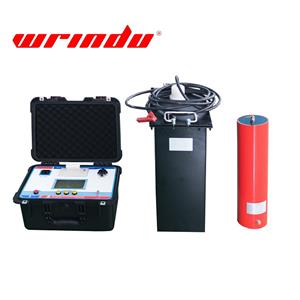
| VLF-Z70Y/YT/YF/YTF | Control unit + voltage booster | 50 kg + 65 kg | 52 × 50 × 68 cm (control unit) |
| VLF-Z80Y/YT/YF/YTF | Control unit + voltage booster | 50 kg + 65 kg | 52 × 50 × 68 cm (control unit) + 49 × 48 × 79 cm (voltage booster) |
The 30kV and 40kV models have a packaged weight of 50 kg, while the 50kV and 60kV models weigh 65 kg after packaging. The 70kV and 80kV models use a separate control unit and voltage booster. Each unit is packed separately, giving a combined packaged weight of approximately 115 kg.
The main difference between the lower-voltage and higher-voltage configurations is the equipment structure and handling requirement. The 30kV–60kV models use an integrated configuration, while the 70kV and 80kV models require customers to transport and handle two separate packages. This is an important consideration for field testing teams working at different locations.
For the four 80kV configurations—RDVLF-Z80Y, RDVLF-Z80YT, RDVLF-Z80YF, and RDVLF-Z80YTF—the physical configuration and weight are the same. Additional tan delta or PD measurement functions do not change the packaging weight. Therefore, customers choosing between these four models should focus on testing requirements rather than weight differences.
When comparing different voltage levels, customers should consider both the required test voltage and the equipment's transportation conditions. A lighter unit may be easier to move, but the selected output voltage and load capacity must still meet the cable testing requirements.
How Can Wrindu Help You Select the Right VLF Test Set?
Wrindu is a China OEM manufacturer of high-voltage testing equipment and power testing solutions. The RDVLF 80kV series provides different configurations for cable withstand testing and insulation diagnosis.
Wrindu can help customers evaluate their cable capacitance, required test voltage, testing frequency, and diagnostic functions before confirming the equipment configuration.
If you are unsure whether the RDVLF-Z80Y, RDVLF-Z80YT, RDVLF-Z80YF, or RDVLF-Z80YTF is suitable for your project, send Wrindu your cable specifications and testing requirements.
Contact Wrindu for technical support and a suitable 80kV VLF test set configuration.