Technology Class
-
1507-2025
dc leakage test
Learn about DC leakage test methods, benefits, and safety tips for effective insulation testing to ensure equipment safety and reliability.
-
1507-2025
how to calculate no load losses of transformer
This article focuses on how to calculate the no-load loss of the transformer, helping you understand the no-load loss more directly.
-
0304-2025
A complete analysis of the use of secondary injection tester
Secondary injection testers act as vital guardians, ensuring the safety of the power grid. The relay protection tester is a crucial tool for verifying their proper function. Whether you're a power system operator, maintenance staff, or a power engineering student, mastering this instrument is essential. This article provides a comprehensive guide to help you become proficient in operating relay protection instruments.
-
2802-2025
The difference between high voltage AC withstand voltage test and DC withstand voltage test
The withstand voltage test is crucial for testing high-voltage equipment, assessing its insulation performance and ability to withstand electric shock, ensuring its safety and reliability. It typically includes two types: AC and DC withstand voltage tests. These tests differ in principles and applications, which will be explained in more detail below.
-
1501-2025
Transformer Comprehensive Test Bench Test Type
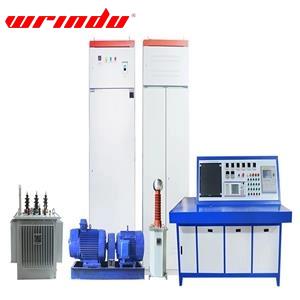
The transformer comprehensive test bench is a professional equipment that integrates multiple test functions and is suitable for the performance evaluation of power transformers and distribution transformers. The equipment not only supports no-load and load characteristic tests, but also can perform double-frequency induction withstand voltage tests and power frequency withstand voltage tests. It is widely used in transformer manufacturing, installation and commissioning, and operation and maintenance.
-
2811-2024
Relay protection CT disconnection detailed explanation
CT disconnection refers to the occurrence of circuit disconnection in the secondary circuit of the current transformer (CT), which will make the secondary side unable to transmit current signals normally to the relay protection device or measuring instrument. The main function of the current transformer is to reduce the large current in the high-voltage line to a safe level in a certain proportion to facilitate the measurement and protection of the equipment to work.
-
2111-2024
A brief discussion on the important role of transformer oil chromatography analysis
The chromatographic analysis method for detecting dissolved gases in transformer oil is essential in discovering latent faults in oil-filled electrical equipment as early as possible. It can detect internal faults of equipment, predict the development trend of faults, and avoid equipment damage and unplanned power outages; according to the harmfulness of the fault, the importance of the equipment, and the load requirements, reasonable fault handling measures are formulated to ensure that the equipment is not damaged. This is an essential means of supervising and ensuring the safe operation of equipment.
-
1811-2024
Common methods of cable fault testing and their advantages and disadvantages
Cables are critical components of power transmission systems, and their health directly affects the safety and stable operation of the entire power grid. Cable failures lead to power supply interruptions and may cause safety accidents. Therefore, timely and accurate detection and location of cable faults are essential for maintaining and managing power systems. This article will explore several standard cable fault testing methods in-depth and analyze their working principles, the scope of application, and advantages and disadvantages.
-
1311-2024
The meaning of winding resistance to transformer maintenance
Among the many maintenance methods, the DC resistance test is widely used in routine transformer inspection. As an effective detection method, the DC resistance test can help engineers find potential problems in time and ensure the reliability and safety of the equipment.
-
1211-2024
Emergency handling process after cable failure
In the power system, cable failure will not only affect the continuity of the power supply but also may cause equipment damage and safety accidents. Therefore, power engineers need to master a complete set of emergency handling processes to quickly restore the power supply and ensure the safety of the system and personnel. The following is a detailed emergency handling process that aims to provide effective and practical guidance for power engineers.