Why is Loop Resistance Tester Essential for Electrical Systems?
Loop resistance testing is an important procedure used to ensure the safety and efficiency of electrical systems, particularly high-voltage equipment such as circuit breakers, transformers, and cables. This test helps verify that protective devices, like fuses and breakers, operate correctly during faults, preventing potential failures and ensuring the safe operation of power grids. In this article, we’ll dive into what loop resistance testers are, how they work, and why they are crucial for maintaining electrical system reliability.
What Is Loop Resistance Testing?
Loop resistance testing measures the resistance of electrical contacts in systems like switchgear and transformers to ensure proper current flow during faults. The test is essential for verifying that electrical protective devices can operate as expected, allowing the current to pass through the system and trigger protective mechanisms such as breakers and fuses.
Loop resistance testing is typically performed in high-voltage environments where any resistance or poor contact could lead to overheating, insulation damage, or even catastrophic failures. Tools like Wrindu's loop resistance testers help ensure that these critical components function reliably, maintaining the overall safety and performance of the electrical system.
Why Is Loop Resistance Testing Important?
Loop resistance testing is crucial for the following reasons:
Preventing Overheating: Poor contacts can lead to excessive heating, which increases the risk of electrical fires or equipment damage.
Ensuring Proper Protection: The test confirms that electrical protective devices will trip in case of a fault, helping to prevent system failures and equipment damage.
Maintaining System Integrity: Regular testing helps identify hidden issues like oxidation or loose connections, which could compromise the reliability of the system.
Wrindu, a leading manufacturer of loop resistance testers, emphasizes the importance of routine testing for ensuring grid reliability and preventing costly downtimes in power utilities and OEM systems.
How Does a Loop Resistance Tester Work?
A loop resistance tester typically uses a DC current to test the resistance of electrical contacts in high-voltage systems. The process involves applying a current across the contacts, measuring the resulting voltage drop, and then calculating the resistance using Ohm's law. Wrindu's testers use the four-terminal Kelvin method, which eliminates errors caused by lead resistance, providing more accurate and reliable results.
Loop Testing Process
| Step | Action | Description |
|---|---|---|
| Preparation | Clean the contacts | Remove any dirt, oxidation, or debris from the contacts to ensure accurate testing. |
| Test Application | Apply the test current (100A-200A) | Use a high DC current to pass through the electrical contacts to measure resistance. |
| Voltage Drop Measurement | Measure the voltage drop across the loop | Record the voltage drop across the contacts to calculate resistance using Ohm’s law. |
| Resistance Calculation | Calculate the resistance using Ohm's law ( R = \frac{V}{I} ) | Use the voltage drop and test current to calculate the loop resistance. |
| Comparison | Compare the resistance to standard specifications | Ensure that the recorded resistance is below the standard limit (usually 50µΩ for high-voltage breakers). |
What Are the Different Methods of Loop Resistance Testing?
Loop resistance testing can be performed using various methods, each suited to different scenarios and applications. The primary methods include:
DC Voltage Drop Method
This method is the simplest and most commonly used for field testing. It applies a DC current to the loop and measures the voltage drop across the contacts to calculate the resistance. It’s effective for breakers and other protective devices.
Four-Terminal (Kelvin) Method
This method separates the current and voltage leads, ensuring that only the resistance of the contact is measured. The Kelvin method is highly accurate and ideal for low-resistance measurements, making it suitable for laboratory testing.
High-Frequency AC Method
Used for online testing, this method applies high-frequency AC current to the system, providing fast and minimally disruptive testing. It is commonly used for live-line testing in environments where equipment cannot be shut down.
Wrindu's loop resistance testers integrate these testing methods, allowing for flexibility in various applications, from high-voltage breakers to online equipment testing.
What Equipment Is Needed for Loop Resistance Testing?
Loop resistance testing requires specific equipment to ensure accurate measurements and safe operations. Essential tools include:
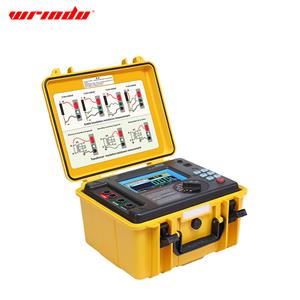
Loop Resistance Tester: The primary tool for conducting the test. Wrindu's RDHL-200A series offers test currents of 100A/200A DC and a resolution of 0.1µΩ for high-precision testing.
C-Clamps: Used to clamp onto the electrical contacts for testing.
Safety Gear: Protective equipment to ensure operator safety during testing.
Calibration Standards: Tools for verifying the accuracy of the tester.
For B2B wholesale clients, Wrindu offers portable, rugged testers that meet global standards, making them ideal for use in substations and power plants.
Wrindu RDHL-200A Loop Resistance Tester Features
| Feature | Wrindu RDHL-200A Specs | Benefit |
|---|---|---|
| Test Current | 100A/200A DC | Penetrates surface films |
| Range/Resolution | 0-50mΩ / 0.1µΩ | High precision |
| Display | 7″ Touch LCD | User-friendly, ideal for onsite use |
| Accuracy | ±0.5% | Reliable, accurate data |
Click to find information about Wrindu Loop Resistance Tester.
How to Choose the Right Loop Resistance Tester?
When selecting a loop resistance tester, consider the following factors:
Current Output: Choose a tester with a test current of 100A/200A for high-voltage breakers to ensure accurate results.
Accuracy: Look for a tester with high accuracy (±0.5%) and a resolution of at least 0.1µΩ for precise measurements.
Portability: For fieldwork, select battery-powered units that are easy to transport.
Compliance: Ensure that the tester complies with IEC standards for reliable and industry-compliant testing.
Wrindu's RDHL series is designed to meet these needs, offering portable and versatile solutions for a variety of applications.
What Standards Govern Loop Resistance Testing?
Loop resistance testing is governed by international standards to ensure consistent and accurate results. Key standards include:
IEC 62382: Specifies the requirements for loop testing of protective devices in electrical systems.
DL/T845.4-2004: Outlines resistance limits for electrical grids in China, setting a maximum limit of 50µΩ for high-voltage breakers.
Wrindu's testers are designed to meet these standards, ensuring compliance and accuracy across global markets.